
How to manage and reduce absence in your business
Within this guide, we’ll discuss:
- Why managing and reducing absence is important
- How you can track absence
- How you can understand the cause of absence in your business
- How to take action to reduce absence
Why managing and reducing absence is important
The silent cost of absence
The bottom line is that absence costs you A LOT of money. In 2020, absence cost UK business owners approx. £7bn. Can you believe it?
While colds and flus are unavoidable and it’s expected for your employees to take the odd day off here and there, it is important to keep a close eye on how much absence could be costing your business.
How can you calculate the cost to your business? You need to think about the knock-on effect.
Not only is their salary still being paid, but this causes a resourcing issue for you, their workload often falls on the shoulders of their colleagues, which can lead to decreased productivity, missed deadlines and possible disruptions to client relationships.
How you can track absence
The easiest way for you to keep a close eye on absence is to track it using HR software like Breathe HR. Software like this allows you to automatically record, monitor and report on trends; giving you all of the insights you need to understand how much of an issue absence is to your business.
How you can understand the cause of absence in your business
Return-to-work interviews
Carrying out return-to-work interviews is the easiest way for you to understand why employees are taking time off from work. In some cases, these interviews can be enough to make people think twice about pulling a sickie.
There are various templates and frameworks you can use to help you conduct your return-to-work interview, which is something we can help you with.
Top reasons for absence in the UK
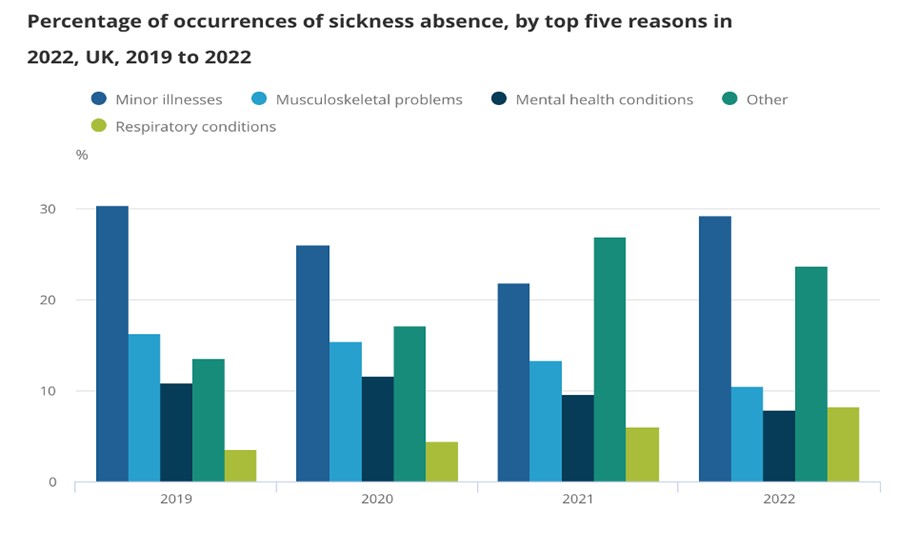
Taken from the Office of National Statistics
How to take action to reduce absence
The action you take to reduce absence will, of course, depend on why your employees are taking time off to begin with. And you may need to investigate these areas further by conducting employee surveys to fully understand what needs to be fixed.
However, there are some general areas we typically look at right away including:
- Cultivate a culture of wellbeing: Prioritise the physical and mental health of your team to create a positive and supportive work environment.
- Flexible working arrangements: Embrace flexibility to accommodate the diverse needs of your team, promoting a healthy work/life balance.
- Training and development opportunities: Invest in the growth of your employees, creating a sense of purpose and reducing monotony.
- Clear communication: Establish open lines of communication to address concerns promptly and build trust within your team.
- Recognition and reward: Acknowledge and appreciate the efforts of your team to boost morale and commitment.
- Promote open conversations about mental health: Break down the stigma surrounding mental health through open and honest discussions.
- Provide mental health resources and support: Give your team the resources to manage their mental health effectively.
- Encourage regular breaks: Create a culture of taking breaks and engaging in mindfulness to recharge mental batteries.
- Promote a healthy work/life balance: Set clear expectations around working hours to promote a healthy balance between work and personal life.
- Train managers in mental health awareness: Empower managers to recognise signs of stress and provide support to their team members.
- Identify and address stressors: Pinpoint the root causes of stress within your workplace and implement targeted solutions.
- Use the Bradford Score for stress management: Use the Bradford Score to identify patterns of short-term absences, a potential indicator of stress-related issues.
- Implement stress-reducing initiatives: Introduce initiatives that proactively address stress, such as wellness programs and stress management workshops.
Need help reducing absence in your business?
If you would like to improve absence in your business, get in touch with us today.