
What the new uncapped unfair dismissal compensation means for your business
From January 2027, dismissing an employee and re-engaging them on less favourable terms (“fire and rehire”) will, in most cases, be automatically unfair. Employees will not need any qualifying service to bring a claim, significantly increasing the risks for employers considering this approach.
Most small business owners aren’t aware when they’re “firing and rehiring”. But that’s what it’s called when you end someone’s contract and offer them a new one with worse terms.

January’s new rules cover changes to pay, working hours, time off and pensions. If the employee doesn’t agree to the change and you dismiss them to push it through, that’s automatically unfair from January.
There is one exception, but it’s narrow. You would need to show your business was facing genuine financial distress that threatened its survival and that there was no other reasonable way to avoid it. “We needed to save money” won’t be enough.
If you’ve changed anyone’s terms recently by ending one contract and starting another, or if you’re planning to, review those arrangements before January. If in doubt, get advice before you act.

What we’ve been up to
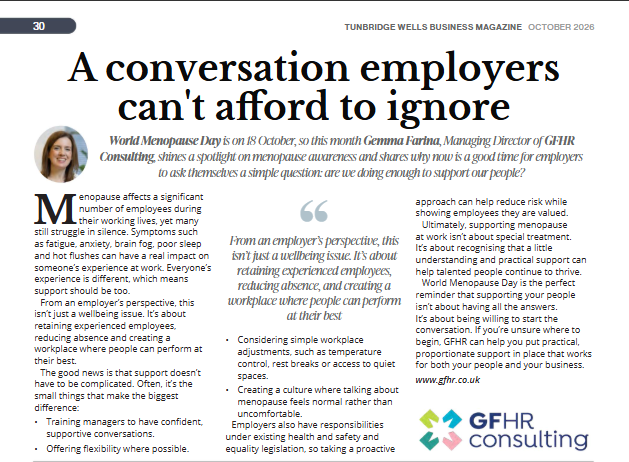
This month Gemma was featured in Tunbridge Wells Business magazine with an article focusing on menopause in the workplace. The article highlights the impact menopausal symptoms can have on employees and shares practical ways employers can create a more supportive working environment. You can read it here.
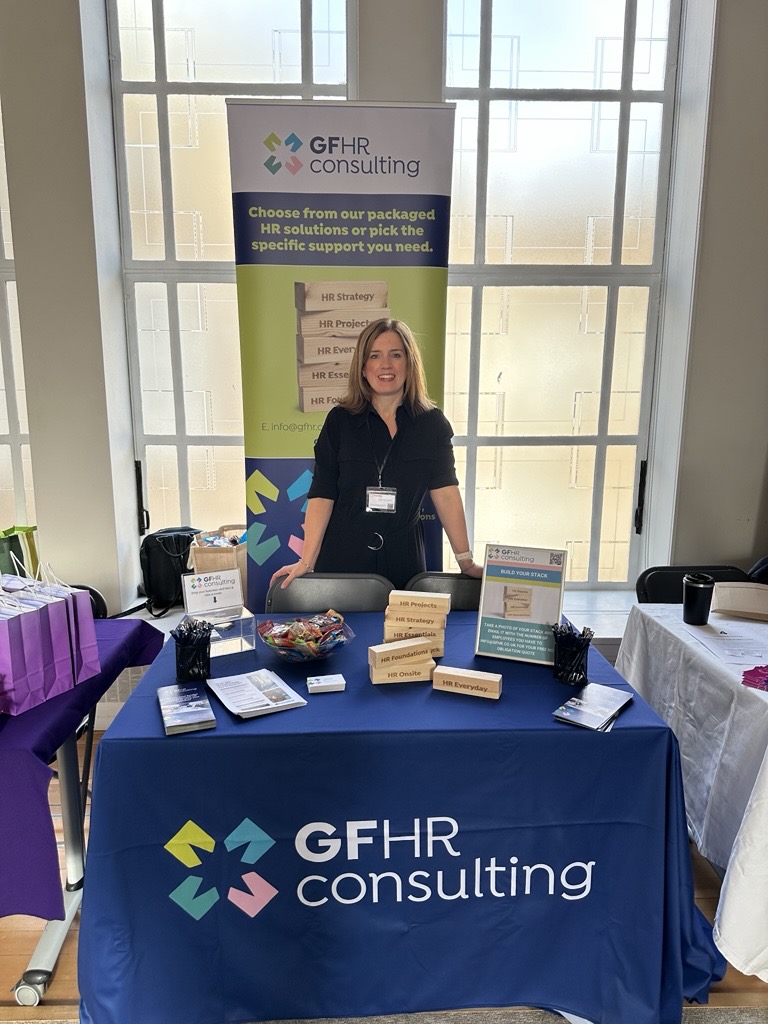
We exhibited at the Town Hall Expo. It was a fantastic opportunity to reconnect with familiar faces, meet new contacts, and build valuable local business relationships. Thank you to everyone who stopped by to speak with us.
Finally, we were delighted to hear that Gemma has been shortlisted as a finalist in the Businesswomen of the year and GFHR is also on the shortlist in the Small Business category at the Tunbridge Wells Business Awards this year. Congratulations to all the finalists announced this week, we are particularly looking forward to seeing who wins the Large Business Award which we are sponsoring this year.
Dates for Your Diary
2 – 6th November – International Stress Awareness week, a timely reminder that workplace stress doesn’t just affect employee wellbeing, it can also impact productivity, engagement and attendance. As an employer, it is a good opportunity to review how you support mental health, identify sources of workplace stress, and ensure managers are equipped to have open, supportive conversations with their teams.
5 November – Tunbridge Wells Business Show, come and see us at the Assembly Hall Theatre on Stand number 3.
10 November – Tunbridge Wells Business Awards, a wonderful evening, celebrating the wonderful businesses of Tunbridge Wells.
Zero-hours contract consultation: what employers need to know before 2027
The government has closed its consultation on new rules for zero-hours and low-hours contracts, with changes expected to take effect in 2027.
Under the proposals, employers will have to offer qualifying workers a guaranteed-hours contract that reflects the hours they actually work over a reference period, likely 12 weeks. Workers will be able to turn down the offer and stay on their current arrangement.
New rights to a reasonable notice of shifts and compensation for last-minute cancellations are also part of the package.
The final details are still being worked out, including the threshold for low-hours contracts (the government’s preference is somewhere between 8 and 20 hours per week).
If you use zero-hours, casual or bank staff, now is a good time to audit those arrangements and get a picture of who would be affected.
Employee on medication dismissed for being “under the influence”
An employee with bipolar disorder took her usual medication at lunchtime rather than the evening. Within an hour, she experienced drowsiness, confusion and impaired speech, and fell asleep at her desk. Three colleagues witnessed it. Nobody asked if she was OK.
The next day, she was suspended for being “under the influence”. She was later dismissed for gross misconduct.
The tribunal found that the investigation was “seriously flawed”. The employer never contacted the café she’d visited at lunch (which doesn’t serve alcohol), never asked about her medication and never explored any alternative explanation. The judge said no reasonable employer would have dismissed in those circumstances.
The employee was awarded nearly £50,000.
If someone in your team is behaving unusually, the first question should be whether they’re alright. There may be a medical explanation and jumping straight to misconduct without investigating properly can turn a single incident into a very costly one.
Acas is rewriting its disciplinary and grievance code for the first time since 2009
Acas has consulted on a full rewrite of its Code of Practice on disciplinary and grievance procedures. The consultation closed in September and the final version hasn’t been published yet, but the direction of travel is clear.
The biggest change is that informal resolution is being brought into the statutory code for the first time.
Right now, the suggestion to try resolving things informally sits in the foreword, which tribunals don’t have to consider. Under the new draft, it becomes part of the code itself. This means that if you skip straight to a formal process without trying to sort things out informally first, a tribunal could take that into account when deciding compensation, including the 25% uplift.
If you’re already having informal conversations when issues come up, you’re ahead of this. Just make sure that you’re writing them down, even briefly. A conversation you can’t evidence is a conversation that didn’t happen.
Your Christmas party is now a harassment compliance test
This is the first Christmas party season since the harassment duty changed in October. If something goes wrong at your work event and you can’t show that you took all reasonable steps to prevent it, you’ll be liable.
Two things changed in October 2026. The duty to prevent sexual harassment upgraded from “reasonable steps” to “all reasonable steps”. And employers are now liable for harassment of their staff by third parties, including customers, clients, contractors and anyone else at the event.
A work Christmas party is a work event. This means that everything that happens there, including what your staff say to each other and what guests or plus-ones say to your team, falls under your responsibility.

What a tribunal will ask is what you did beforehand to prevent it. So here are four things worth putting in place before any social event this season.
- Do a brief written risk assessment. Even a one-page document is enough, as long as it exists and you’ve acted on it.
- Brief your managers on what to look out for and how to respond if something happens.
- Make sure that there is a clear way for staff to report an incident, including outside normal working hours.
- Follow up after the event. If something is reported, act on it.
These steps won’t guarantee that you’re covered, but they go a long way toward showing a tribunal that you took the duty seriously.
If you’d like help with putting this in place before your Christmas event, get in touch.

Can I still make someone redundant and offer them a different role?
Yes, genuine redundancy is still lawful.
But, from January 2027, if you dismiss someone and offer them a substantially similar role on worse terms, that could be reclassified as fire and rehire, which is automatically unfair.
The key question is whether the new role is genuinely different or just the old one with worse pay or conditions. Document your business rationale, consult properly and take advice before acting.
Ask about our Redundancy Pack if you are facing this situation.
Do I need to do a risk assessment before our Christmas party?
Yes. Since October, the harassment duty requires you to take “all reasonable steps” to prevent harassment and a work social event counts as a work event.
If something happens and you have no risk assessment, you have no defence. It doesn’t need to be long.
Cover the basics: alcohol, mixed attendees, such as clients or suppliers, venue layout, how staff can report an incident and which managers are briefed. Keep a copy.
Our Prevent & Protect package can help you prepare like a pro!
What should I do if an employee tells me that they are experiencing domestic abuse?
There’s no legal requirement to have a standalone domestic abuse policy, but your duty of care and health and safety obligations still apply.
Respond sensitively and offer confidentiality. Consider whether reasonable adjustments would help, such as flexible hours, changed contact details or a safe working arrangement. Signpost specialist support services. If your managers haven’t been trained on how to handle a disclosure like this, that’s worth addressing.
We can recommend specialist services if a situation arises.
